
Bioproduction & Research

Kalundborg industry represents many different types of production activities ranging from fermentation, downstream processing and chemical modification to distillation, utility systems, IT & automation.

Explore these activities further in the six categories below describing related research areas, involved supervisors and specialists as well as relevant Fellowship projects.

Fermentation

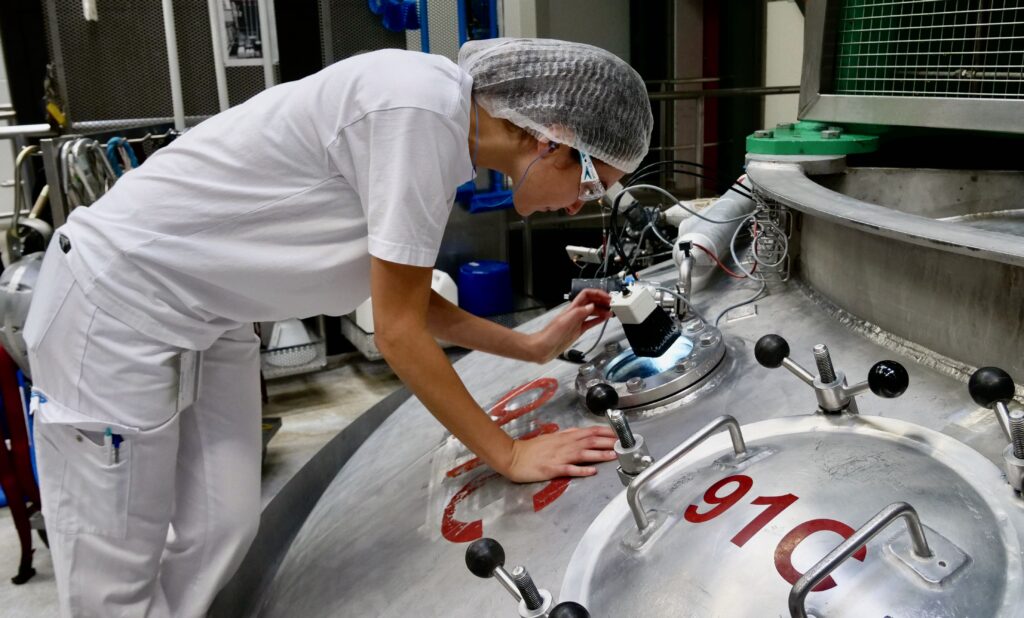
It all began back in the early 1970s when Novo Industri established a production facility in Kalundborg. Now, 50 years later, new companies are again establishing fermentation plants in the area. Fermentation with natural or genetically engineered bacteria and yeast is fundamental to a broad range of industrial activities in Kalundborg ranging from the large industrial-scale production of enzymes, protein feed, food and pharmaceuticals to the small-scale wine production on the Røsnæs peninsula.

Downstream Processing

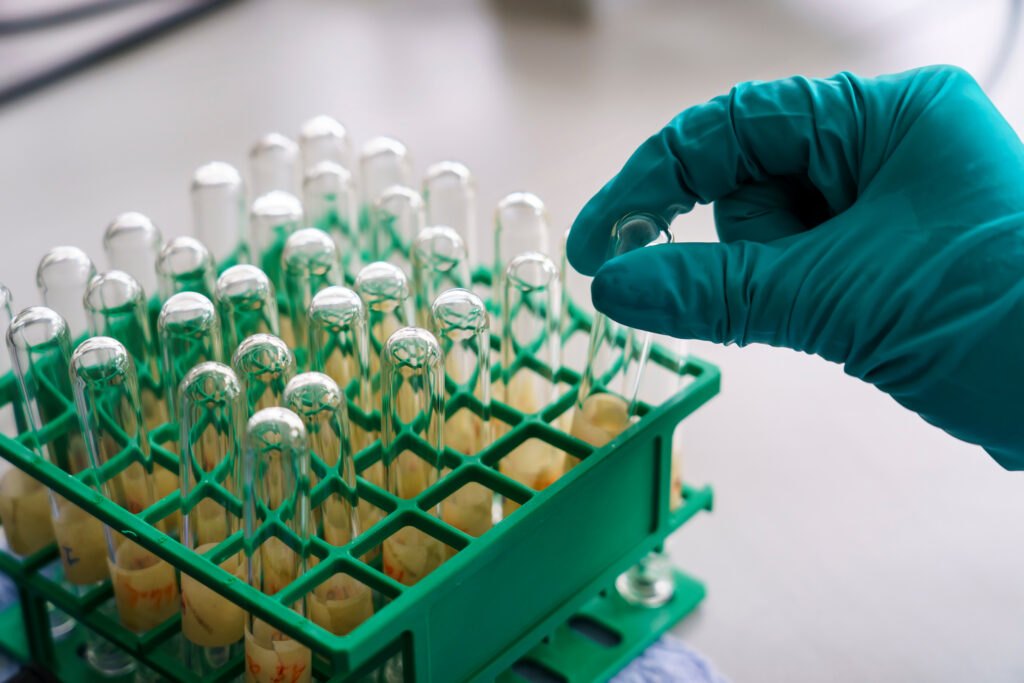
Recovery and purification of biological and chemical products in a series of processes are carried out in many of the Kalundborg industries. These processes are among others separation by centrifugation and filtration, product recovery, extraction and product purification, as well as chemical modification, distillation, crystallization and various drying methods for the final product. As a result of this, there are numerous possibilities for students and their supervisors to work with, explore and optimize downstream processes.

Chemical Processes

It all began back in the early 1970s when Novo Industri established a production facility in Kalundborg. Now, 50 years later, new companies are again establishing fermentation plants in the area. Fermentation with natural or genetically engineered bacteria and yeast is fundamental to a broad range of industrial activities in Kalundborg ranging from the large industrial-scale production of enzymes, protein feed, food and pharmaceuticals to the small-scale wine production on the Røsnæs peninsula.

Downstream Processing

Recovery and purification of biological and chemical products in a series of processes are carried out in many of the Kalundborg industries. These processes are among others separation by centrifugation and filtration, product recovery, extraction and product purification, as well as chemical modification, distillation, crystallization and various drying methods for the final product. As a result of this, there are numerous possibilities for students and their supervisors to work with, explore and optimize downstream processes.

Water & Utility

It all began back in the early 1970s when Novo Industri established a production facility in Kalundborg. Now, 50 years later, new companies are again establishing fermentation plants in the area. Fermentation with natural or genetically engineered bacteria and yeast is fundamental to a broad range of industrial activities in Kalundborg ranging from the large industrial-scale production of enzymes, protein feed, food and pharmaceuticals to the small-scale wine production on the Røsnæs peninsula.

Data & Digitalization

Recovery and purification of biological and chemical products in a series of processes are carried out in many of the Kalundborg industries. These processes are among others separation by centrifugation and filtration, product recovery, extraction and product purification, as well as chemical modification, distillation, crystallization and various drying methods for the final product. As a result of this, there are numerous possibilities for students and their supervisors to work with, explore and optimize downstream processes.

Automation & Robotics

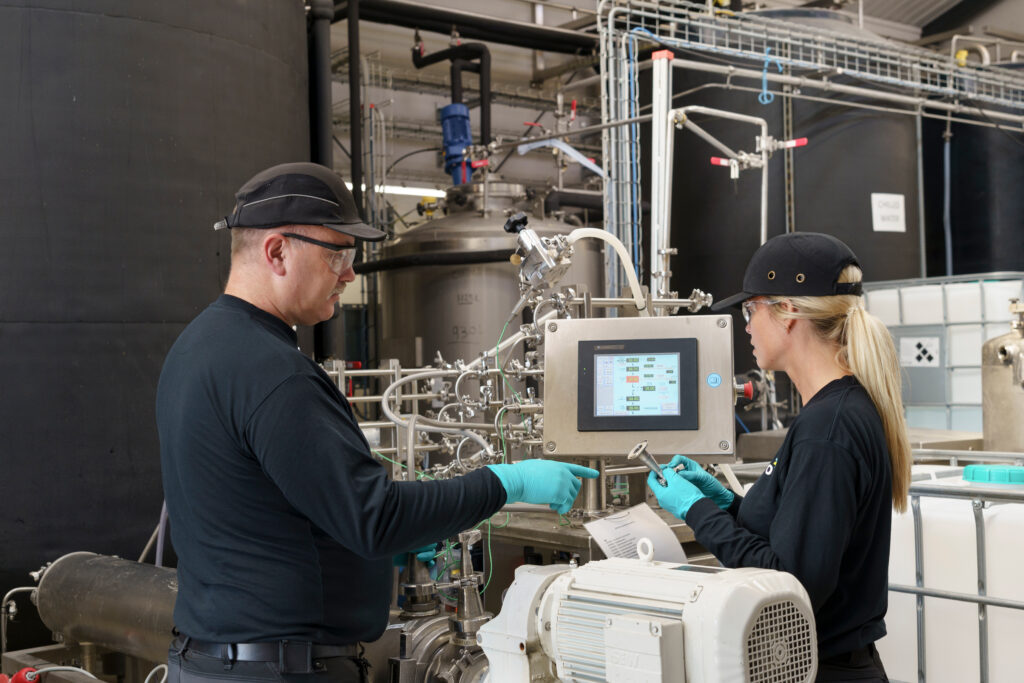
In almost all industries manual work is rapidly being replaced by automated solutions to improve productivity and standardize processes. The industry in Kalundborg is rapidly integrating automatic solutions for manufacturing. Older factories are undergoing massive rebuilding and investment in order to implement new technology. New facilities are highly automated from day 1. Automation includes fully automatic production lines, the use of stationary and mobile robots and cobots, and the use of vision- and sensor technologies in all areas of production.

Across a wide range of industries there is an accelerating shift from manual operations to automated systems, fueled by the drive to enhance productivity and standardize procedures. This transformation has over the past few years been unfolding with remarkable speed in Kalundborg’s industry, where automation is progressively enhancing the manufacturing processes, with new factories integrating high levels of automation from inception. The scope of automation extends to fully automated production lines, deployment of stationary and mobile robots, and collaborative robots, often referred to as ‘cobots’. Additionally, vision and sensor technologies are becoming widespread across all facets of production, further driving the technological revolution.
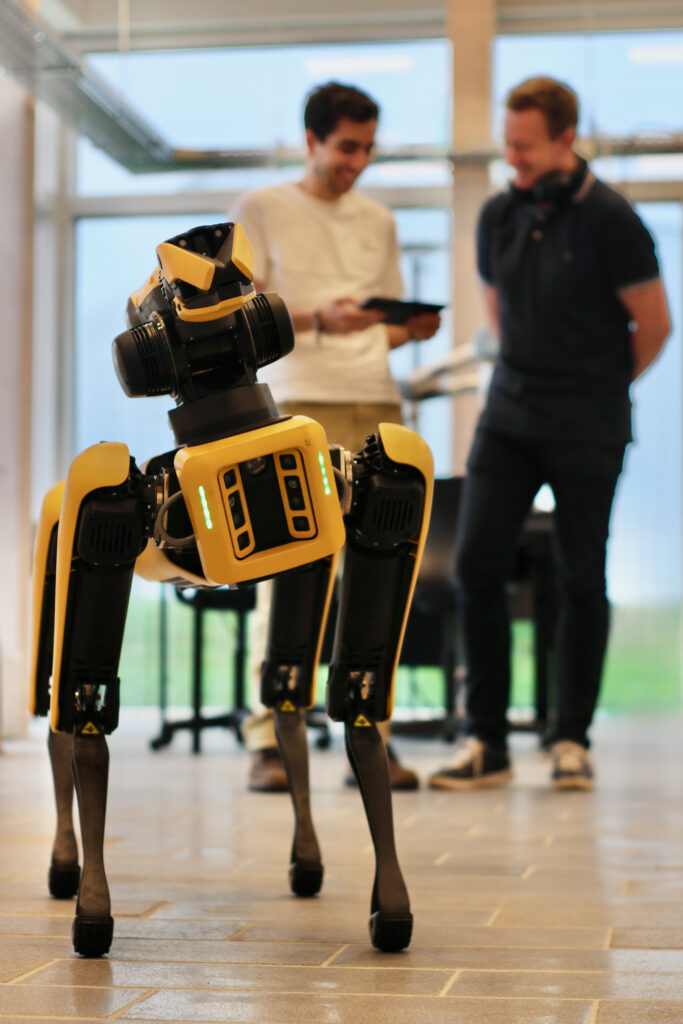
Robot dog

Computer Vision have over the past few years become more and more prevalent in the industry. Among the innovative uses of computer vision in the industry, are the applications in predictive maintenance and product inspection. Together with mobile robotic platforms like drones or quadruped robots (robotic dogs) the applications of computer vision can be greatly amplified, especially when it comes to predictive maintenance.

By equipping the platforms with cameras and specialized sensors they can together with a given route and schedule be used to perform inspection and other duties across a wider area. By levering the versatility of these robotic platforms, the inspection of equipment or machinery in remote, hazardous, or hard-to-access locations becomes significantly less challenging, occasionally even removing the need for a human operator.


While traditional robots have revolutionized the handling and transportation of items within and between factories, the emergence of collaborative robots, also known as “cobots,” is reshaping the way workers tackle repetitive, labor-intensive or non-ergonomic tasks. By leveraging the intuitive user-interface provided by cobots, workers can, with minimal training, automate mundane tasks that previously required repetitive movements, extended periods of waiting for the next item in line, or the transport of heavy objects to different locations.

Together with the emergence of more sophisticated AI the way workers are interacting with robotic systems is changing drastically, improving the way they instruct, collaborate and train the new systems to perform increasingly complex tasks. With the rise of advanced language models setting up a task for a robotic system to complete might evolve into a discussion rather that than a lengthy programming task. Moreover, this conversation-driven interaction can open the door to dynamic problem solving and on-the-fly adjustments. Robots enabled with AI could ask clarifying questions when instructions are unclear, suggest alternatives based on previous experiences, or even proactively identify and resolve issues before they develop into bigger problems.

Fermentation

It all began back in the early 1970s when Novo Industri established a production facility in Kalundborg. Now, 50 years later, new companies are again establishing fermentation plants in the area. Fermentation with natural or genetically engineered bacteria and yeast is fundamental to a broad range of industrial activities in Kalundborg ranging from the large industrial-scale production of enzymes, protein feed, food and pharmaceuticals to the small-scale wine production on the Røsnæs peninsula.

Item #1

Downstream Processing

Lorem ipsum dolor sit amet, consectetur adipiscing elit. Ut elit tellus, luctus nec ullamcorper mattis, pulvinar dapibus leo.

Item #1

Chemical Processes

Lorem ipsum dolor sit amet, consectetur adipiscing elit. Ut elit tellus, luctus nec ullamcorper mattis, pulvinar dapibus leo.

Item #1

Water & Utility

Lorem ipsum dolor sit amet, consectetur adipiscing elit. Ut elit tellus, luctus nec ullamcorper mattis, pulvinar dapibus leo.

Item #1

Data & Digitalization

Lorem ipsum dolor sit amet, consectetur adipiscing elit. Ut elit tellus, luctus nec ullamcorper mattis, pulvinar dapibus leo.

Item #1

Automation & Robotics

Lorem ipsum dolor sit amet, consectetur adipiscing elit. Ut elit tellus, luctus nec ullamcorper mattis, pulvinar dapibus leo.

Item #1